Extruded net
Diamond or square openings from a melt process. Ask which extrusion die and strand size the factory is quoting.
FACTORY COMPARISON / FIRST ORDER
Compare quotes from up to 3 factories
FREE review of product, quantity, destination and sourcing requirements
Eligible first orders may receive up to 3%
Eligibility applies to qualified business buyers and is confirmed after we review your product, quantity, destination, and sourcing requirements. Final figures depend on supplier confirmation, product type and order value. This is not a discount, lowest-price, or today-only offer.
Plastic Mesh Sourcing is an independent procurement desk for US business buyers. We do not manufacture plastic mesh, hold a warehouse, or publish a price list. A complete brief names construction (extruded or woven), thickness or strand size in inches or millimetres, opening size, quantity, destination, and whether the line ships as a roll or a plastic mesh sheet.
US search observation for this family (Ahrefs export dated 2026-07-22; home-term row observed 2026-07-07) recorded Volume 2100 for plastic mesh. That figure is a past measurement, not current rank or a promised inquiry volume.
Diamond or square openings from a melt process. Ask which extrusion die and strand size the factory is quoting.
Warp and weft yarns. Opening and yarn denier belong on the same line.
Width and roll length versus cut sheet size. Do not leave “standard pack” blank.
UV stabilizer / HALS, if outdoor service is intended. A plant ISO 9001 file is not a UV rating.
These cards are request prompts. Density 0.94 g/cm³ for HDPE or a tensile strength range printed on a brochure is that factory’s claim for that line, not a rating Plastic Mesh Sourcing reprints as its own.
Ask for the current technical data sheet and SDS that name the quoted mesh, not a family flyer. If density in g/cm³ is how you distinguish resin, the TDS must show the method.
| Ask for | Why it matters |
|---|---|
| Density (g/cm³) | Separates HDPE from other polyolefins when the buyer uses it |
| UV stabilizer / HALS | Outdoor service is not implied by a black colour |
hdpe mesh, thermoplastic mesh and polyethylene plastic mesh are leftover measured strings. They are not five stocked SKUs. The factory must say whether they map to the same construction.
| Buyer string | Question to write |
|---|---|
| hdpe mesh | Is the resin HDPE, and which density method is cited? |
| thermoplastic mesh | Which polymer family and melt process are quoted? |
This desk does not host a mesh configurator. Send opening size, strand size and width on the request so a factory CAD or die drawing can be compared later.
Send the axes you haveThese groups stay the buyer’s decision. Plastic Mesh Sourcing will copy them onto each factory request; we will not fill missing numbers from a brochure.
| Axis | What the factory must write |
|---|---|
| Thickness or strand size | Inches or millimetres; “standard mesh” is not a size |
| Opening size | Clear opening, not a marketing mesh count unless you define the count |
| Width and form | Roll width and length, or sheet length × width |
| Axis | What the factory must write |
|---|---|
| Density in g/cm³ | Only if you use it to distinguish resin; cite the method |
| UV stabilizer / HALS | Package name or hours, with the ASTM or equivalent method |
| Colour / masterbatch | Separate from UV; a colour chip is not a weather file |
| Axis | What the factory must write |
|---|---|
| Quantity | By configuration, not as a lump across forms |
| Packing | Rolls on a pallet, sheets interleaved, or gaylord |
| Documents | Lot TDS, dimensional report, named ASTM method — not a company certificate alone |
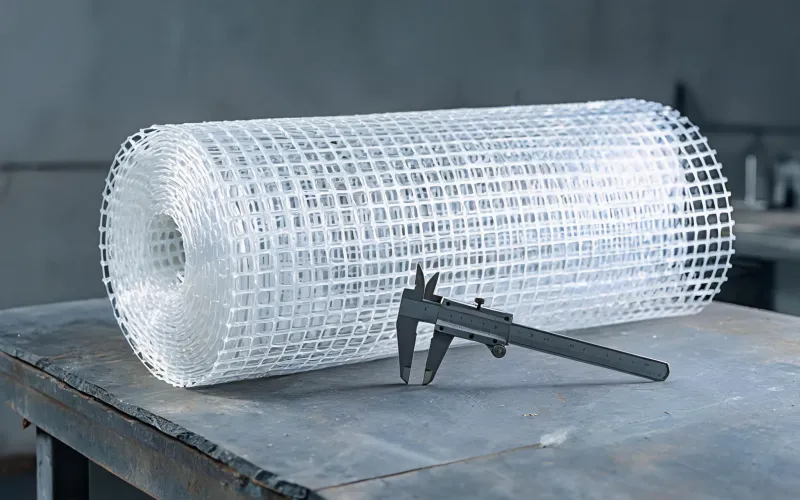
Extruded, woven, roll, sheet or UV-stabilized. Neighbouring wording is not a substitute until the factory writes the mapping.
Strand size, opening, width and UV package travel together. A cheaper unit price on a different Incoterm is a different deal.
A plant ISO 9001 file does not stand in for a dimensional page on the quoted mesh.
State US state or postal code and whether a sample must be approved before the production lot.
These cards translate a use into axes. They are not field-performance guarantees. plastic mesh fencing has its own page because opening size and UV package change with the site, not because this desk installs fence.
Representative part: barrier or shade mesh. Key axes: opening, UV stabilizer / HALS, roll width. File: supplier UV method, not a farm result.
Representative part: temporary fence fabric. Key axes: opening, colour, roll length. File: lot dimensional page.
Representative part: tray or conveyor overlay. Key axes: strand size, opening, resin density in g/cm³ if used. File: named ASTM method.
Representative part: pallet mesh. Key axes: width, elongation at break if the buyer uses it. File: TDS for the quoted grade.
Representative part: cut sheet inserts. Key axes: sheet size, thickness, colour/masterbatch. File: drawing confirmation.
Representative part: only when the buyer names food-contact. Key axes: FDA 21 CFR 177 grade and lot. File: grade-specific declaration, not a company letter.
Procurement scenario, not a customer testimonial: a buyer sent “plastic mesh” without saying extruded versus woven. Two factories answered different openings and one omitted UV. The unit prices were not comparable until strand size, opening and UV method sat on one line.
Share construction, strand size, opening, quantity and destination. We copy the same line to factories and compare replies. We do not promise a clock-time SLA or a market-beating percentage.